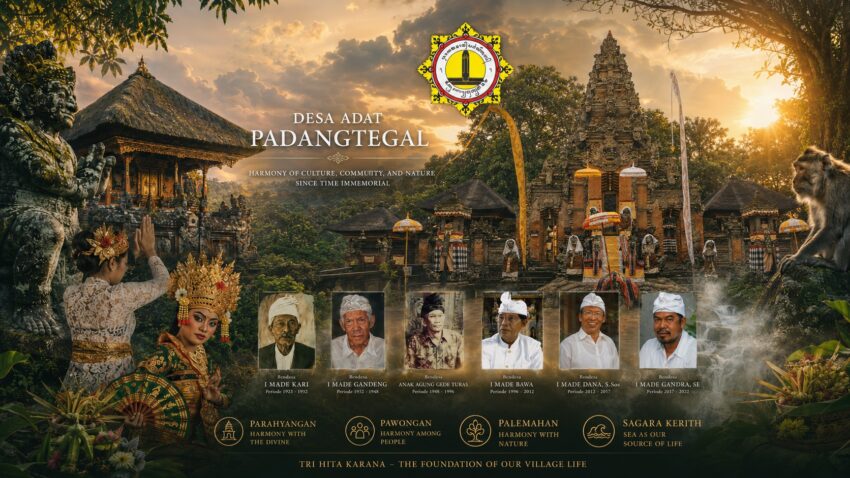
Padangtegal Village, Ubud
Located in the cultural heart of Ubud, Gianyar Regency, Bali, Padangtegal is a traditional Balinese village, or Desa Adat, known for its sacred temples, strong community values, living traditions, and deep relationship with nature. Padangtegal is part of the wider Kelurahan Ubud area, yet it maintains its own customary identity through its adat institutions, temple networks, communal responsibilities, and traditional laws.
Covering approximately 134 hectares, Padangtegal is home to a close-knit customary community organized through banjar, temple obligations, ritual life, and village governance. A 2022 customary document recorded around 676 households within Desa Adat Padangtegal. The village is internationally recognized as the home of the Sacred Monkey Forest Sanctuary, locally known as Mandala Suci Wenara Wana, one of Bali’s most iconic sacred, cultural, and conservation landscapes.
More than a destination, Padangtegal is a living village where spirituality, nature, community, and tourism are managed together under the Balinese philosophy of Tri Hita Karana.
Historical Roots
The history of Padangtegal is best understood as a layered story of sacred memory, temple heritage, customary governance, and modern community development.
Local historical narratives connect the sacred origins of Pura Dalem Agung Padangtegal to the Bali Kuno period, around 894–895 CE. This early date is preserved through traditional calendrical interpretation, oral testimony, ritual memory, and local sacred knowledge. However, because no inscription or definitive archaeological proof naming Pura Dalem Agung Padangtegal has yet been found, this early chronology should be understood as part of the village’s sacred memory rather than as a fully confirmed archaeological date.
The more conservative and widely accepted public chronology places the main temple complex within the Sacred Monkey Forest Sanctuary around the mid-14th century. This period is associated with the broader Majapahit-era reorganization of Balinese temple systems, village institutions, ritual calendars, and sacred landscapes. The temples of Pura Dalem Agung, Pura Beji, and Pura Prajapati are therefore central to the historical identity of Padangtegal.
Over time, Padangtegal developed as a spiritual and agricultural settlement. Early communities built temples, cultivated fertile land, maintained irrigation traditions, and organized village life around sacred obligations. The village grew through the principles of Tri Hita Karana, which teaches harmony between God, human beings, and nature.
In the 20th century, Padangtegal experienced the wider transformation of Ubud from an agrarian area into a cultural and tourism center. Ubud’s modern administrative development is recorded from the early 20th century, and in 1981 Ubud formally became a kelurahan. Within this structure, Padangtegal continued to exist as a Desa Adat, maintaining its customary authority, religious identity, and community institutions.
A major turning point came in 1982, when Mandala Suci Wenara Wana was formally developed as a tourism and conservation site. This marked the beginning of Padangtegal’s modern model of community-based tourism. In 1987, the founding of LPD Padangtegal further strengthened the village economy by helping local capital circulate within the community.
Geography and Environment
Padangtegal is located in central Ubud, surrounded by tropical vegetation, rivers, traditional settlements, rice fields, sacred groves, and temple landscapes. Its environment reflects the Balinese understanding that nature is not separate from spiritual life, but part of a sacred relationship between humans, the divine, and the natural world.
The village is traditionally organized into four main community units, commonly referred to as banjar or local subunits. These include:
- Banjar Padangtegal Kaja
- Banjar Padangtegal Kelod
- Banjar Mekarsari
- Banjar Padang Kencana
Some public sources use slightly different terminology, including Padangtegal Tengah. This reflects the difference between customary and administrative naming systems, which are related but not always identical.
The southern part of Padangtegal is home to the Sacred Monkey Forest Sanctuary, covering approximately 12.5 hectares. The forest contains hundreds of Balinese long-tailed macaques, known scientifically as Macaca fascicularis, as well as a rich collection of tropical trees, sacred banyans, pule trees, rivers, stone carvings, and ancient temple structures.
The forest is locally called Wenara Wana, meaning the forest of sacred monkeys. It may also be understood as a Hutan Yadnya, a sacred forest that supports ritual offerings, ceremonies, purification, and the spiritual life of the community.
Sacred Monkey Forest Sanctuary
The Sacred Monkey Forest Sanctuary, or Mandala Suci Wenara Wana, is one of the most important landmarks of Padangtegal. It is not only a tourism destination, but also a sacred conservation area, educational space, spiritual landscape, and village-owned community institution.
The sanctuary protects the forest environment, the macaque population, ancient temples, sacred water sources, and ritual pathways. It also plays an important role in supporting village development, religious ceremonies, conservation programs, cultural preservation, and community welfare.
What makes the Monkey Forest unique is that it remains rooted in the authority of Desa Adat Padangtegal. Its management is connected to the customary village structure, ensuring that tourism development supports local culture rather than replacing it.
The forest represents the living relationship between people, animals, temples, and nature. In Padangtegal, macaques are not seen merely as wildlife or tourist attractions. They are part of a sacred ecosystem connected to offerings, temple life, ritual space, and the balance between the seen and unseen worlds.
Temples of Padangtegal
The spiritual structure of Padangtegal follows the traditional Balinese temple system. It includes the main village temples, known as Pura Kahyangan Tiga, and several supporting temples, known as Pura Manca. Together, they form a sacred network that maintains the spiritual balance of the village.
Pura Desa lan Puseh Padangtegal
Pura Desa lan Puseh Padangtegal serves as the central and origin temple of the village. It is associated with the worship of Brahma, the Creator, and Vishnu, the Preserver. This temple is used for major communal ceremonies, including the village temple anniversary, or piodalan desa.
As a civic and religious center, Pura Desa lan Puseh also plays an important role in village deliberation, customary life, and collective ceremonies. It reflects the origin, unity, and spiritual foundation of Desa Adat Padangtegal.
Pura Dalem Agung Padangtegal
Located inside the Sacred Monkey Forest Sanctuary, Pura Dalem Agung Padangtegal is one of the most important sacred sites in the village. It is dedicated to Lord Shiva, who symbolizes transformation, dissolution, renewal, and the cycle of life and death.
Pura Dalem Agung is closely connected to ancestral rites, pitra yadnya, cremation ceremonies, and the spiritual relationship between the visible and invisible worlds. It is believed by the community to have deep sacred antiquity, while the visible temple complex is commonly associated with the mid-14th century.
This temple forms the spiritual heart of the Monkey Forest and remains central to Padangtegal’s religious identity.
Pura Beji
Pura Beji is a purification temple associated with holy water, cleansing, and renewal. It is connected to melukat, or purification rituals, and is often used before major temple ceremonies.
Dedicated to the sacred power of water, Pura Beji symbolizes spiritual cleansing, balance, and the restoration of purity. Its presence within the forest highlights the importance of rivers, springs, and water sources in Balinese ritual life.
Pura Prajapati
Pura Prajapati is located near the cemetery and is associated with the transition between life and death. It plays an important role in rituals connected to cremation and the care of the soul before the final ceremonies are completed.
Spiritually, Pura Prajapati is closely connected with Pura Dalem Agung. Together, they represent the cycle of birth, life, death, purification, and rebirth. This relationship makes the Monkey Forest not only a natural sanctuary, but also a sacred landscape of life-cycle rituals.
Supporting Temples
In addition to the main temples, Padangtegal also has supporting temples that serve specific spiritual, ancestral, agricultural, and protective functions.
Pura Kloncing functions as a guardian temple connected to village protection and spiritual balance.
Pura Panti Pasek Tohjiwa serves members of the Pasek Tohjiwa lineage and preserves ancestral worship within the community.
Pura Padangkerta / Pasek Padang Subadra is an ancestral temple connected to family lineage, offerings, and spiritual continuity.
Pura Taman Sari is associated with beauty, fertility, agriculture, prosperity, and blessings connected to Dewi Sri, the goddess of rice and abundance.
Together, these temples show how Padangtegal’s sacred geography extends beyond one site. The village is a living network of ritual spaces, each supporting a different aspect of community life.
Community Organization and Governance
Padangtegal operates under the Desa Adat system, a customary village structure that exists alongside the formal administrative system of Kelurahan Ubud. This dual structure is common in Bali, where civil administration and customary authority often overlap but serve different roles.
Desa Adat Padangtegal is guided by traditional law, including awig-awig and pararem. These customary rules regulate village responsibilities, leadership, temple obligations, social conduct, ceremonies, and the relationship between people, land, and sacred institutions.
The village leadership structure includes:
Bendesa Adat
The head of the customary village, responsible for cultural, spiritual, and customary matters.
Prajuru Adat
Customary officials who assist in governance, religious coordination, community administration, and village programs.
Banjar Adat
Local community units that organize social activities, ceremonies, mutual assistance, and daily communal responsibilities.
Sabha Desa and Kerta Desa
Customary bodies that support deliberation, guidance, and dispute resolution within the village.
Pemangku
Temple priests who conduct offerings, maintain temple rituals, and guide religious ceremonies.
Krama Desa
Members of the customary village who participate in communal duties, ceremonies, temple responsibilities, and village service known as ayahan.
This system ensures that Padangtegal is not simply a geographical area, but a living customary community with shared responsibilities and sacred obligations.
Customary Law and Village Identity
Padangtegal’s identity is strongly supported by its customary laws. Historical records show that Padangtegal has maintained written forms of awig-awig, including older regulations and renewed customary law adapted to modern village conditions.
In 2013, the village updated and ratified its awig-awig to strengthen customary order in response to contemporary realities, including tourism, social development, and community growth. Later customary documents, including pararem, continued to define leadership, territory, village institutions, and community responsibilities.
This shows that adat in Padangtegal is not static. It is a living system that continues to adapt while preserving the village’s spiritual foundation.
Economy, Culture, and Sustainability
Padangtegal’s economy combines tourism, arts, culture, local enterprise, traditional agriculture, and community-based institutions. The Sacred Monkey Forest Sanctuary is the village’s most important tourism and conservation center. Revenue generated through the sanctuary supports religious ceremonies, temple restoration, environmental protection, education, community welfare, and village development.
The village economy is also supported by local businesses, arts and cultural activities, homestays, restaurants, handicrafts, and services connected to Ubud’s tourism ecosystem. However, Padangtegal’s approach is distinctive because tourism remains connected to customary governance and community benefit.
Important village initiatives include:
- Temple preservation and restoration
- Forest and wildlife conservation
- Waste management and composting programs
- Parking and traffic management
- Support for education and community welfare
- Preservation of Balinese dance, music, crafts, and ceremonies
- Maintenance of agricultural and subak-related heritage
Padangtegal has also developed environmental programs such as community waste management and composting systems. These efforts reflect the village’s commitment to addressing the pressures of tourism while maintaining ecological balance.
Tourism and Conservation
Tourism has brought significant opportunities to Padangtegal, but also responsibilities. The growth of visitors to the Sacred Monkey Forest Sanctuary has supported the local economy and strengthened village institutions. At the same time, tourism has created challenges such as traffic congestion, land-use pressure, waste management, and human–macaque interaction.
Padangtegal has responded through adat-based management, conservation planning, improved infrastructure, parking organization, environmental programs, and community supervision. The Monkey Forest is managed not only as a visitor attraction, but as a sacred ecosystem that requires protection, balance, and respect.
The relationship between humans and macaques remains an important part of daily life in the village. The macaques are part of the forest’s ecology and sacred atmosphere, but their presence also requires careful management. Padangtegal’s conservation approach therefore seeks to balance animal welfare, visitor safety, community comfort, and spiritual values.
Cultural Philosophy: Tri Hita Karana
The life of Padangtegal is guided by Tri Hita Karana, the Balinese philosophy of three harmonies:
Parahyangan — harmony with God, expressed through temple ceremonies, offerings, prayer, and devotion.
Pawongan — harmony among people, expressed through cooperation, mutual respect, social responsibility, and community service.
Palemahan — harmony with nature, expressed through forest protection, river care, environmental stewardship, and respect for sacred landscapes.
This philosophy is not only a cultural idea. It is the foundation of village governance, temple life, tourism management, conservation, social organization, and daily practice.
Through Tri Hita Karana, Padangtegal continues to protect the balance between spiritual life, community welfare, and environmental sustainability.
Padangtegal Today
Today, Padangtegal stands as one of Ubud’s most important traditional communities. It is a village where ancient temples remain active, sacred forests are protected, ceremonies continue, and customary governance guides modern development.
The village shows how tradition and tourism can coexist when managed through community responsibility. Rather than allowing tourism to replace culture, Padangtegal has integrated tourism into a wider mission of cultural preservation, environmental conservation, and social welfare.
Visitors who come to Padangtegal encounter more than a famous forest or a popular destination. They enter a living cultural landscape shaped by temples, rituals, macaques, rivers, trees, community life, and sacred memory.
The Spirit of Padangtegal
Padangtegal is more than a village in Ubud. It is a living expression of Balinese harmony.
Its sacred temples connect the community with the divine. Its banjar and adat institutions connect people through shared responsibility. Its forest, rivers, and macaques connect the village with nature. Together, these elements form the identity of Desa Adat Padangtegal.
Through the continuing practice of Tri Hita Karana, Padangtegal preserves its heritage while moving toward a sustainable future — protecting culture, nurturing nature, and strengthening community for generations to come.